


 (916) 313-3030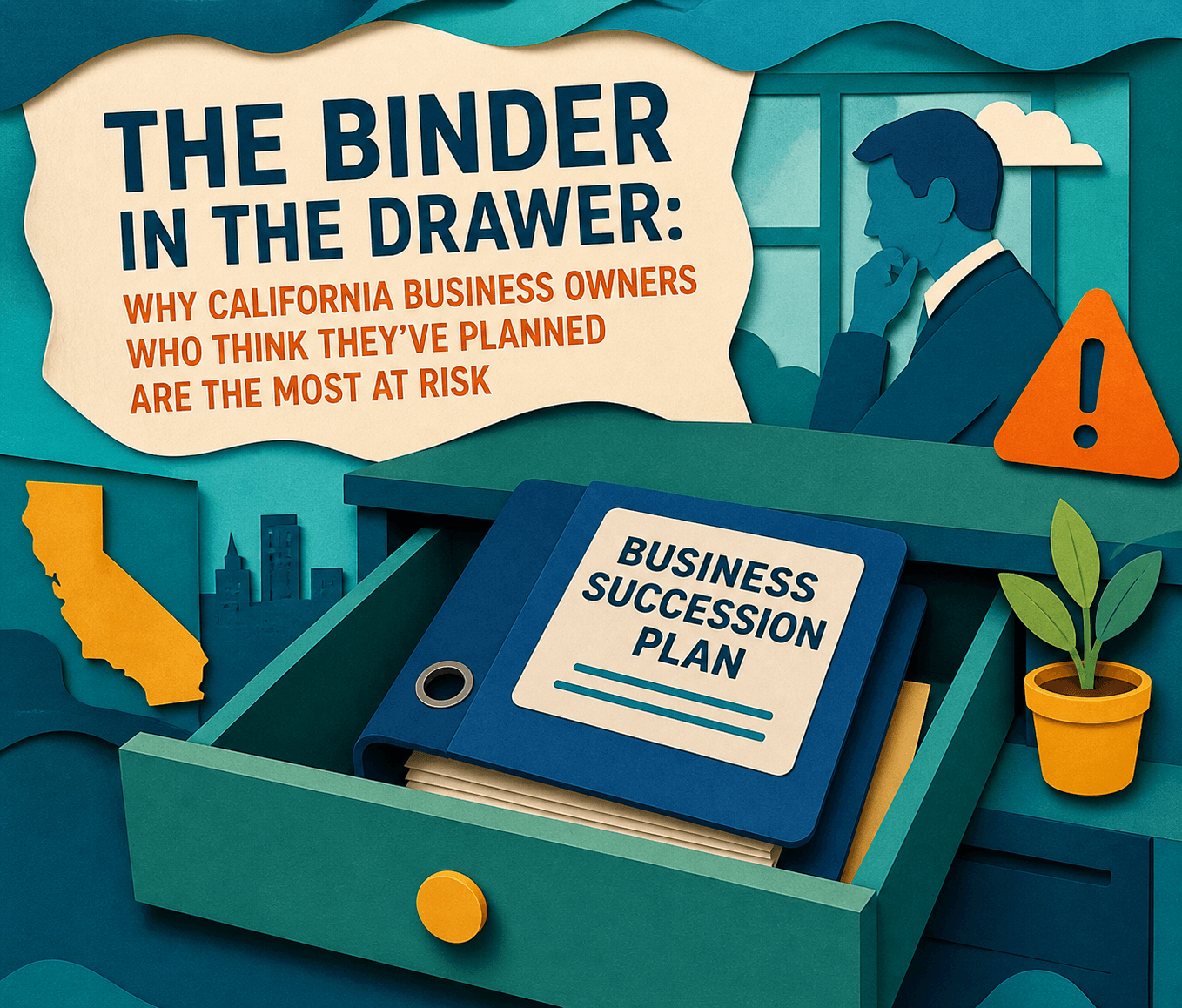
The Binder in the Drawer: Why California Business Owners Who Think They’ve Planned Are the Most at Risk

A California business owner passes away after decades of building a company that employs forty people and carries the family name on the sign out front. He had a will. He had talked with his kids about the business. He had even met with an attorney once, a few years back, and walked out with a binder full of documents. What he did not have was a succession plan that actually worked.
Within six months, two of his three children are in litigation, the company’s longtime general manager has accepted a position across town, and a probate court is presiding over the future of the business he spent thirty years building. This is not a hypothetical. Variations of this story arrive at our office regularly, and understanding why it happens is the first step toward making sure it does not happen to your family.
For California business owners thinking about what a business succession planning lawyer can actually offer, the honest answer begins here: the absence of a clear, legally documented succession structure does not produce a neutral outcome. It produces a contested one.
What “No Succession Plan” Actually Means in California
When people say they do not have a succession plan, they often mean something more specific than they realize. They may have a will. They may have a trust document sitting in a drawer. They may have told their eldest child, repeatedly, over many years, exactly what they wanted to happen with the business. None of that constitutes a succession plan in any legally operative sense, and the gap between intention and documentation is where businesses are lost and where litigation begins.
The “I told my kids” fallacy is one of the most costly misconceptions in California estate law. Verbal instructions, even those repeated over decades at kitchen tables and holiday dinners, carry no legal operative weight whatsoever. By communicating his wishes to his family for thirty years, a business owner has not established any legally binding framework. The law does not inquire about his words when he passes away. It inquires about what he signed, what was observed, and what was correctly carried out in compliance with California’s legal requirements. Families break down in the space between those two things.
California is a community property state, which adds a layer that many owners do not anticipate when they believe they have things handled. A business built or substantially grown during a marriage may be characterized, at least in part, as community property, meaning a surviving spouse carries a legal interest in the company regardless of whether they appear in any succession document the owner prepared.
When the owner’s succession intentions conflict with community property rights, the result is frequently contested and almost always complicated. This is the detail that stops people cold when they hear it for the first time, because it means the owner’s children and the owner’s spouse may have competing legal claims to the same operating business, and that a probate court will be sorting out who gets what.
How Probate Swallows a Family Business
When a business interest is held in an owner’s personal name, death triggers California’s probate process. There is no private transfer, no seamless handoff to the next generation. The business enters a public, court-supervised proceeding that can run for a year or longer, and the outcome is determined by statute and a judge, not by the owner’s values or vision for the company he built.
The cost of probate is real, but it is not the most destructive element for a family business. The management vacuum is. When an owner dies without a designated successor who has both legal authority and operational familiarity, the business enters a period of paralysis. Vendors need someone to authorise payments. Employees need someone to sign the payroll. Contracts require a counterparty with legal standing. The probate court will eventually appoint a personal representative, but that process takes time, and the business does not pause while the paperwork catches up.
Key employees are particularly sensitive to this uncertainty. A general manager who has spent fifteen years building relationships with clients and suppliers is not going to wait indefinitely while a family sorts out its legal situation in court. He has options, and he will use them.
The institutional knowledge that leaves with a departing employee is rarely captured in any document, and it cannot be recovered through litigation. The six-month collapse pattern is not an exaggeration. Within six months of an unplanned owner’s death, sibling litigation has typically begun, key personnel have departed, and the probate court has become the de facto board of directors for a company that was never designed to be governed by judicial oversight.
The Sibling Litigation Timeline
Rarely does the litigation that follows the unexpected death of a business owner start out maliciously. Ambiguity is the first step. Because she worked for the company for twenty years, one child feels that it was promised to her. Another feels that all three siblings should receive an equal share of the estate, regardless of who contributed what. A third thinks the company should be sold and the proceeds divided. All three may speak with the owner to bolster their claims, but none of those discussions will be accepted as legally binding directives.
What follows is a will contest, a trust dispute, or both, depending on what documents exist and how they were drafted. Poor drafting by an estate planning lawyer is itself a significant source of litigation, because ambiguous language in a trust or will does not resolve itself in favor of anyone’s good intentions. Documents are interpreted by courts as written, and litigation fills in the blanks when the writing is ambiguous. Under the stress of grief and financial uncertainty, families who thought they were on the same page find that their perceptions of the owner’s true desires differ greatly.
Although the financial cost of this litigation is significant, there are other costs as well. Before any distribution takes place, a company’s value may be significantly lowered by attorney fees, court expenses, expert witnesses, business valuations, and the opportunity cost of management time spent on legal proceedings. Although more difficult to measure, the emotional cost to the family is nonetheless real. Even after the lawsuit is over, siblings who grew up together and worked side by side in a family business can become adversaries in a way that is rarely reconciled.
What a Legally Sound Succession Plan Actually Contains
A document binder is not a plan. What makes it through a courtroom is a plan. The distinction is important because many business owners have created a structure that will not withstand the pressure of a contested estate despite having taken certain actions, signed certain documents, and believed they were protected.
For a California business owner, a legally sound succession plan usually consists of multiple coordinated components. Whether through a buy-sell agreement, a trust transfer, or an entity restructuring to enable a specified transfer mechanism, the ownership structure of the business itself needs to be addressed. For instance, a buy-sell agreement financed by life insurance enables a designated successor to buy the owner’s interest at a fixed price, removing the company from the probate estate completely and providing the successor with the financial and legal means to carry on with business as usual.
The trust structure matters enormously. A revocable living trust that holds the business interest avoids probate, but it does not by itself resolve questions of management authority, valuation, or the competing claims of a surviving spouse under California community property law. Those issues require additional planning layers, often including a marital property agreement, a carefully drafted trust that addresses the business specifically, and coordination with the entity’s governing documents, whether those are an operating agreement, shareholder agreement, or partnership agreement.
The human component of succession planning is just as crucial but frequently overlooked. Preparing a successor is not the same as identifying one. A purposeful transition period is necessary for a business that relies on the owner’s connections, standing, and institutional expertise. During this time, the successor is introduced to customers, suppliers, and important staff members in order to foster trust. This change cannot take place after death. Before sharing authority becomes involuntary due to death or incapacity, the owner must be present, involved, and willing to do so.
When Incapacity Precedes Death
Succession planning is not only about what happens when an owner dies. Cognitive decline, serious illness, or sudden incapacity can create the same management vacuum years before death occurs, and the legal tools required to address incapacity are different from those that govern post-death transfer.
A durable power of attorney authorises a designated agent to act on the owner’s behalf in financial and business matters, but its scope and limitations depend entirely on how it is drafted. A power of attorney that does not specifically address the business, or that is drafted broadly enough to invite misuse, can become a source of conflict rather than a solution. The risks arising from misused power of attorney are well documented, and families navigating this situation often discover that the document meant to protect the owner has become a tool for exploitation.
For business owners concerned about cognitive decline affecting their capacity to manage the company, the succession plan must address the transfer of management authority during their lifetimes, not only at death. This may involve a gradual transfer of operational responsibility to a successor, a restructuring of the entity to allow for co-management, or the appointment of an independent manager or board with defined authority during any period of incapacity.
The Role of a Succession Lawyer Before the Crisis Arrives
One thing unites the families who avoid the six-month collapse pattern: they consulted a succession lawyer prior to the emergency. Not after the owner’s condition deteriorated. Not following a diagnosis. earlier. Planning under pressure is qualitatively different from planning before any urgency arises, as it permits deliberate decisions rather than reactive ones.
A succession lawyer who handles estate litigation brings a perspective that a transactional attorney alone cannot provide. Having seen what happens when plans fail, having represented the children who are fighting over a business their father believed he had protected, and having watched probate courts preside over companies that were never designed for judicial governance, the litigation-experienced succession lawyer knows exactly where the documents will be challenged and exactly what language will not hold up. That knowledge shapes the planning in ways that matter when the plan is eventually tested.
California business owners in Sacramento, Los Angeles, and throughout the state who are ready to close the gap between what they intend and what the law will actually enforce can reach our team through the Sacramento office or the Los Angeles office.
 Michael Hackard is the founder of Hackard Law, a California trust and estate litigation firm with more than five decades of experience protecting the inheritance rights of families across Sacramento, the San Francisco Bay Area, and Los Angeles. He is the author of four published books on inheritance protection and has produced more than 1,000 educational videos with over seven million views.