


 (916) 313-3030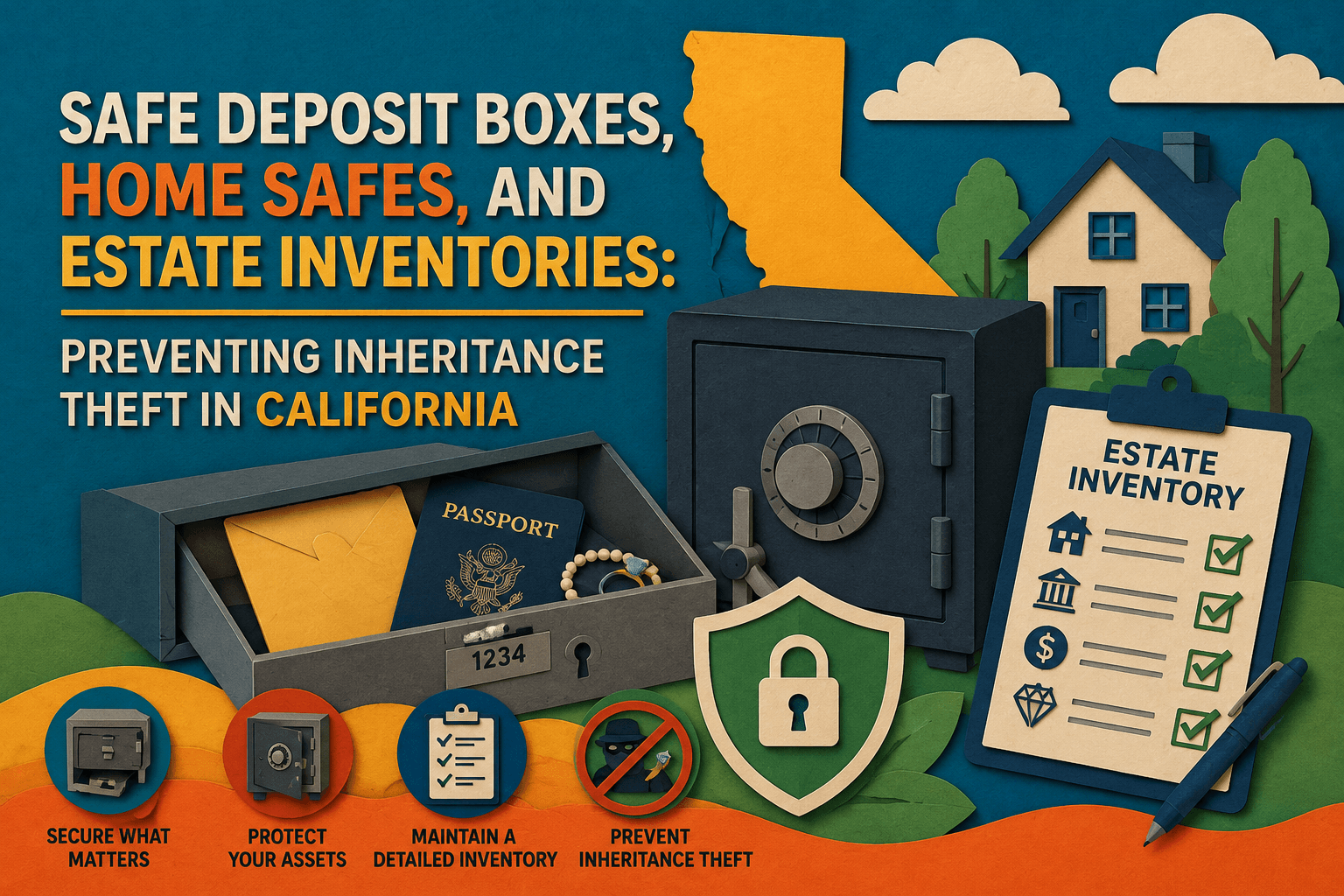
Safe Deposit Boxes, Home Safes, and Estate Inventories: Preventing Inheritance Theft in California

Why a Simple Inventory Can Protect Your Family’s Inheritance
I’m Michael Hackard, founder of Hackard Law. Over my five decades of practice, I have fought for heirs, beneficiaries, and elder abuse victims across California – from Sacramento and the San Francisco Bay Area to Los Angeles. I have written four books on inheritance protection and produced more than 1,000 educational videos, which have reached over 7 million viewers. One truth runs through all of that work: the simplest oversights in estate planning become the costliest battles in litigation. Safe deposit boxes and home safes sit quietly at the center of more inheritance disputes than most families ever anticipate. A missing inventory – just a dated list of what is inside – can turn a straightforward estate into years of conflict, suspicion, and loss. I want to share what I have learned from litigating these cases so that families can take a few easy steps now and avoid devastating consequences later.
Hackard Law provides contingency fee representation for qualified trust and estate cases – no upfront costs to you. If you have a case you want to discuss, call us at (916) 313-3030.
Quick Summary
Safe deposit boxes and home safes are common in California estates, but the absence of a proper inventory creates serious legal and family problems after a loved one dies.
- California law restricts who can access a safe deposit box after the renter’s death – a death certificate, a valid ID, and the key are all required.
- Home safes are frequently emptied after a trust settlor’s death, and without an inventory, there is no way to verify what was taken.
- A simple, dated inventory – with one copy inside the safe and one copy stored elsewhere – can prevent downstream estate theft and family conflict.
- Heirs, beneficiaries, and elder abuse victims have legal options when assets go missing from a safe or safe deposit box.
- Hackard Law litigates these disputes on a contingency fee basis throughout California.
How California Law Governs Safe Deposit Box Access
Safe deposit boxes in California are not freely accessible to just anyone after a renter passes away. Co-renters may access a box without the other co-renters present, but when the renter is deceased, the person seeking access must present a death certificate, a driver’s license or other valid government-issued ID, and the key to the box. These requirements exist to protect the contents from unauthorized removal.
Despite these protections, disputes continue to arise. In my experience litigating these cases, I have never seen a situation in which a decedent left a safe deposit box inventory for their family. That absence of documentation is where trouble begins. Without a record of what was in the box, there is no baseline – and no way to determine whether anything was removed before or after death.
California’s unclaimed property program maintains a safe deposit box inventory form that serves as a useful starting point. Families doing their own planning would be wise to use a similar format and document birth certificates, death certificates, marriage certificates, a last will and testament, the trust instrument, jewelry, and any other valuables stored in the box.
Case Pattern: A Vanishing Document
In one pattern Hackard Law has litigated, a surviving family member claimed a decedent’s original will had been stored in a safe deposit box. After the death, the box was accessed by a co-renter, and the will was never produced. Because no inventory existed, there was no way to prove the document had ever been there. The dispute over the estate’s distribution lasted years and cost the family far more than a simple inventory would have.
Home Safes: A Different and Harder Problem
Home safes present a more difficult challenge than bank safe deposit boxes. There is no institutional gatekeeper, no required ID check, and no death certificate requirement. When a trust settlor dies, the home safe is often accessible to whoever has the combination or key – and in many cases, that person acts quickly.
Hackard Law has litigated dozens of cases in which one or more parties believed that substantial cash – sometimes hundreds of thousands of dollars – was stored in a decedent’s home safe. Some of those accounts were entirely credible. Gold coins, stacks of hundred-dollar bills, family heirlooms: these are the kinds of assets that disappear without a trace when no inventory exists. The stories come up again and again in contested estate matters across California, from Sacramento County probate litigation to disputes in Alameda County and beyond.
Verification is the main issue. A court cannot verify what was in the safe at the time of death if there is no dated inventory. Because no one took the time to write down what was inside, accusations fly, families break up, and litigation becomes the only way to move forward.
Case Pattern: The Empty Safe
Within days of the death, an adult child of a deceased person consistently obtained access to a home safe. Thereon, other beneficiaries claimed that the safe held substantial amounts of valuables or cash. The case relied solely on credibility because there was no inventory and no witnesses. The financial toll increased with each deposition, and the fracture was frequently too deep for any judgment to mend.
What a Proper Inventory Looks Like
It is not necessary to have an attorney or a notary to create an inventory. All you need is a pen, a date, and honesty. Every item kept in the safe or safe deposit box is listed in a good inventory, along with sufficient information to enable clear identification of each item. Additionally, it should be signed and dated by the person who created it and, if feasible, include approximate values.
One copy should stay inside the safe or safe deposit box. A second copy should be kept in a separate, secure location – and at least one trusted person should know where both copies are. This is not a complicated task, but it is one that most people never complete. For families navigating the most common probate, trust, and estate battles, the absence of this simple document is a recurring source of conflict.
The inventory should be updated whenever the contents change. A note that says “as of [date], this safe contains the following” carries real evidentiary weight if a dispute ever arises. It is not a legal guarantee, but it is far better than silence.
When Assets Go Missing: Legal Options for Families
When cash, jewelry, or other valuables disappear from a home safe or safe deposit box after a death, heirs and beneficiaries are not without options. California law provides remedies for estate theft, and Hackard Law pursues these cases on a contingency fee basis – meaning families do not need to pay upfront to fight back.
Litigation in these cases often involves forensic accounting, witness testimony, and a careful reconstruction of who had access to the safe and when. Courts take these disputes seriously, and estate theft in California is treated as a genuine legal wrong with meaningful consequences for those who commit it. If you believe assets were taken from a loved one’s safe or safe deposit box, the time to act is now – delay allows evidence to disappear and memories to fade.
For families in Southern California, our contingency fee representation options are available in the Los Angeles area, including Glendale and Santa Clara County. For a full overview of how contingency fee arrangements work in trust and estate cases, our contingency fee guide explains the process in plain language.
For decades, I have stood with families who discovered too late that a loved one’s estate had been quietly stripped before they could act. Discovery, forensic analysis, and the pursuit of accountability are not just legal strategies – they are safeguards for families threatened by the kind of quiet theft that happens when no one is watching and no inventory exists. A steadfast commitment to truth restores what dishonesty tried to steal.
Key Definitions
- Safe deposit box: A locked container held at a bank or financial institution, accessible only by the renter, co-renters, or authorized individuals under California law.
- Co-renter: A person listed on the safe deposit box rental agreement who has the right to access the box independently.
- Estate inventory: A dated, written list of assets owned by a decedent or stored in a specific location, used to establish what existed at a given point in time.
- Trust settlor: The person who creates and funds a revocable living trust; also called a grantor or trustor.
- Estate theft: The wrongful taking of assets belonging to a decedent’s estate, whether before or after death.
- Contingency fee: A fee arrangement in which an attorney is paid only if the case results in a recovery – no upfront cost to the client.
- Unclaimed property: Assets that have gone unclaimed by their rightful owner for a specified period, subject to California’s unclaimed property laws.
- Forensic accounting: A focused form of financial investigation used in litigation to trace assets, identify missing funds, and reconstruct financial histories.
- Probate: The court-supervised process of administering a decedent’s estate, including identifying assets, paying debts, and distributing property to heirs.
- Beneficiary: A person or entity entitled to receive assets from a trust, will, or estate.
What to Do Next
- Look for any existing inventory documents in your loved one’s safe deposit box or home safe – even a handwritten note with a date is valuable.
- Get copies of the safe deposit box rental agreement to identify all co-renters and authorized individuals.
- Try to avoid disposing of or moving any contents of a safe before consulting an attorney if you suspect assets are missing.
- Look for bank records, insurance riders, or appraisals that may help establish what valuables existed before death.
- Create your own dated inventory of any safe or safe deposit box you maintain, and store a copy in a separate secure location.
- Tell at least one trusted family member or advisor where your inventory copies are kept.
- Look for California’s unclaimed property safe deposit box inventory form as a starting template for your own documentation.
- Get copies of any relevant trust or will documents stored in the safe deposit box as soon as legally permitted after a death.
- Try to avoid waiting too long to raise concerns – evidence and witness recollections fade quickly in estate disputes.
Call Hackard Law at (916) 313-3030 to discuss your case, and visit our contact page to get started.
CALL THE SAGE | When Experience Matters, Families Listen
🏛️ We practice California trust & estate & elder financial abuse litigation
⚖️ We represent heirs, beneficiaries, and elder abuse victims
🎥 1,000+ educational videos | 7 million+ views | 4 published books
🎯 “After thousands of cases, I see the pattern others miss.”
CONTINGENCY REPRESENTATION – No Win, No Fee
Throughout California: Sacramento | Los Angeles | Bay Area
📞 CALL THE SAGE: (916) 313-3030
Subscribe for weekly insights on:
- Elder financial abuse warning signs and prevention
- Trust and estate litigation strategies
- Inheritance protection for California families
- Family protection strategies
When your inheritance is under attack, Call The Sage.
Hackard Law | 10640 Mather Blvd, Mather CA 95655
Attorney Advertisement | Michael Hackard, State Bar #71067
RELATED VIDEOS
Safe Deposit Boxes in Estate Disputes | Trust Litigation Attorney
An attorney explains how safe deposit boxes become flashpoints in estate disputes.
Are Safe Deposit Boxes Safe? | Trust Litigation
Explores the risks and legal issues surrounding safe deposit boxes in estates.
California Disputed Trusts & Estates | Safecrackers
Covers how missing or emptied safes fuel California trust and estate battles.
Unintended Consequences | Preventing Probate, Trust & Estate Litigation
Discusses how simple oversights in estate planning lead to costly family litigation.
Securing Your Inheritance: High-Stakes Estate and Trust Litigators | Hackard Law
Hackard Law outlines how they fight to protect heirs from inheritance theft.
Untold Stories of Family Estate Disputes | CA Probate Litigation
Real family estate conflict stories illustrating how inheritance disputes unfold in California.
 Michael Hackard is the founder of Hackard Law, a California trust and estate litigation firm with more than five decades of experience protecting the inheritance rights of families across Sacramento, the San Francisco Bay Area, and Los Angeles. He is the author of four published books on inheritance protection and has produced more than 1,000 educational videos with over seven million views.