


 (916) 313-3030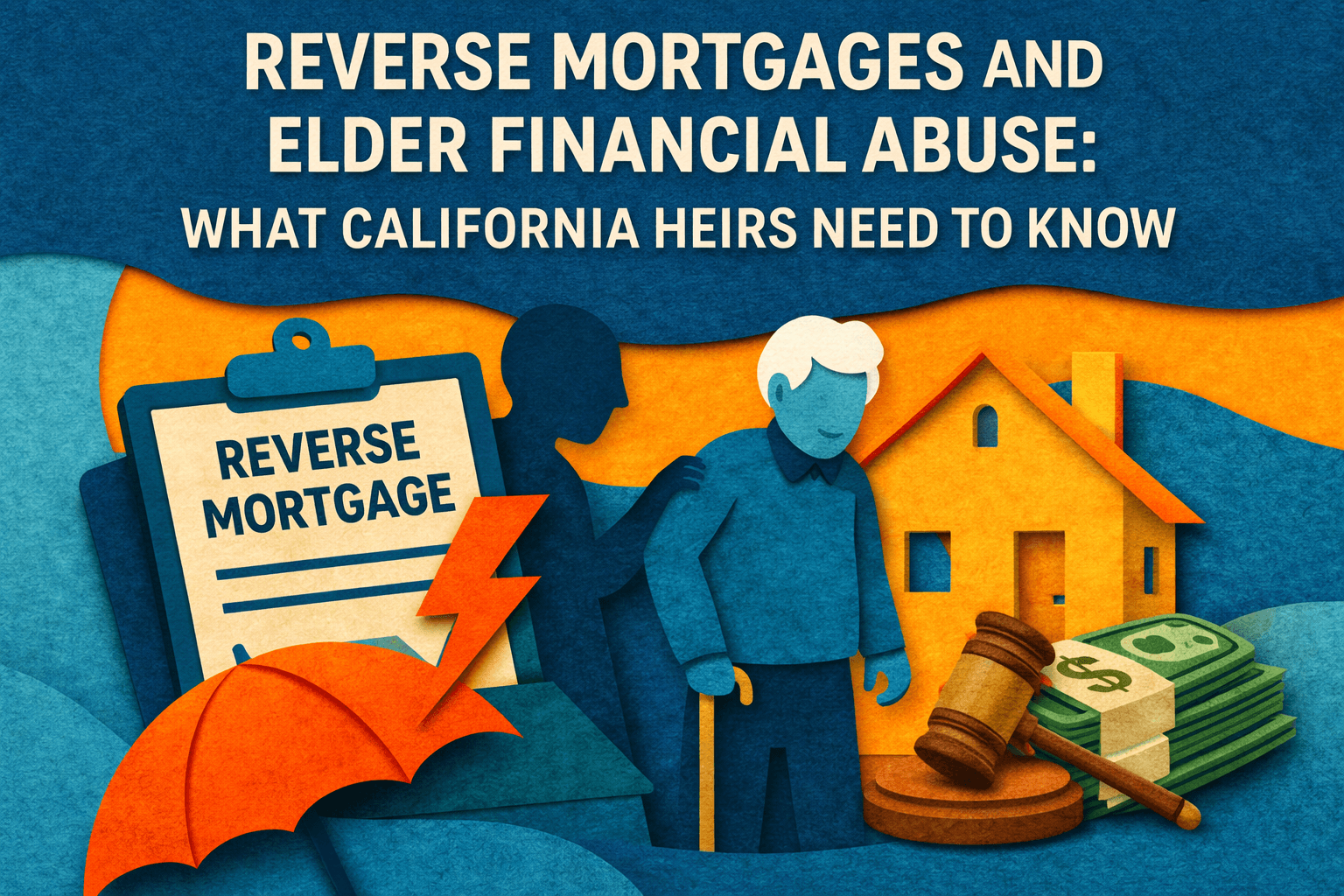
Reverse Mortgages and Elder Financial Abuse: What California Heirs Need to Know

When a Reverse Mortgage Becomes a Red Flag
I am Michael Hackard, founder of Hackard Law, and for more than five decades, I have litigated trust, estate, and elder abuse cases across California. I have written four published books on inheritance protection, and I have produced more than 1,000 educational videos with over seven million views — all aimed at helping families understand their legal rights when an inheritance is at stake. Our firm represents heirs, beneficiaries, and elder abuse victims in Sacramento, the San Francisco Bay Area, and Los Angeles.
Reverse mortgages are a growing source of alarm for California families. Too often, surviving children learn about a parent’s reverse mortgage only after that parent has passed away. The documentation is dense, the terms are confusing, and the financial trail raises more questions than it answers. Reverse mortgages are complex products that are often sold with deceptive advertising, subpar counseling, and actual fraud risks, according to a warning from the Consumer Financial Protection Bureau. When I speak with grieving families who discover that their parents’ home equity has been drained by a reverse mortgage they never knew about, the pattern of exploitation is often unmistakable.
Hackard Law provides contingency fee representation for qualified cases, meaning families pay no upfront legal costs to pursue justice against those who exploited their loved ones.
If your parents’ reverse mortgage raises questions about manipulation, undue influence, or financial abuse, call Hackard Law at (916) 313-3030 for a free consultation.
Quick Summary
Reverse mortgages can be legitimate financial tools, but they are also frequently abused instruments that strip vulnerable seniors of their home equity. California law provides meaningful remedies for heirs and families who discover that a reverse mortgage was procured through undue influence, fraud, or elder financial abuse.
- Reverse mortgages allow homeowners 62 and older to borrow against their home equity, with repayment deferred until the borrower dies or moves out.
- Heirs often discover reverse mortgages only after a parent’s death, leaving little time to investigate and respond.
- Undue influence, high-pressure sales tactics, and fraud taint many reverse mortgage transactions involving elderly borrowers.
- California’s Elder Abuse Act and Welfare and Institutions Code section 15610.30 provide civil remedies, including double damages.
- Hackard Law investigates reverse mortgage abuse and fights to recover stolen equity for families statewide.
How Reverse Mortgages Work — and How They Go Wrong
Homeowners 62 years of age and older can convert a portion of their home equity into cash with a reverse mortgage, most frequently a Home Equity Conversion Mortgage (HECM) covered by the Federal Housing Administration. The money is given to the borrower in the form of monthly payments, a line of credit, or a lump sum. There are no required monthly mortgage payments. When the borrower passes away, sells the house, or stops using it as their primary residence, the loan becomes due.
On paper, these loans serve a purpose. They can provide income to asset-rich but cash-poor seniors. In practice, however, the structure of reverse mortgages creates dangerous openings for abuse. Loan originators earn large commissions. The borrowed funds can be directed to third parties. And the senior borrower, who may already be experiencing cognitive decline, may not fully understand what they have signed or where the money has gone.
The CFPB has repeatedly flagged the risk of elder financial exploitation embedded in the reverse mortgage industry. Misleading advertising, inadequate borrower counseling, and aggressive sales tactics all contribute to an environment where vulnerable seniors can be easily targeted.
Undue Influence and the Reverse Mortgage Pipeline
Undue influence occurs when a person in a position of trust or authority overcomes a vulnerable individual’s free will to benefit themselves or someone else. In the context of reverse mortgages, undue influence frequently involves a family member, caregiver, or financial advisor who pressures a senior into borrowing against their home.
The money from a reverse mortgage does not always stay with the borrower. Hackard Law has identified patterns in which the borrowed funds are quickly transferred to a non-working adult child, a romantic companion, or a caregiver who has gradually assumed financial control over the elder. The senior may not need the money at all. Instead, the reverse mortgage serves as a mechanism to extract wealth from someone too vulnerable to say no.
Under California law, financial transactions that deprive elderly people of their assets may be contested on the grounds of undue influence. Undue influence is broadly defined in Probate Code section 86, and when specific presumptions are met, the burden of proof may shift to the alleged influencer.
Case Pattern: The Caregiver Who Arranged the Loan
In a recurring pattern, a live-in caregiver gradually isolates an aging homeowner from other family members. The caregiver drives the elder to meetings with a mortgage broker, attends the counseling session, and ensures the loan proceeds are deposited into a jointly held account. By the time the elder passes, the home equity has been drained, and the caregiver has disappeared. Families discovering this pattern often have strong claims under California’s Elder Abuse Act.
Where the Money Goes: Tracing Reverse Mortgage Proceeds
One of the most important steps for families investigating a suspicious reverse mortgage is following the money. The loan proceeds leave a financial trail that can reveal exactly who benefited from the transaction and whether the borrower ever controlled or used the funds.
Bank records, wire transfer confirmations, and account statements can show whether loan proceeds were immediately redirected to a third party. Hackard Law works with forensic accountants and financial investigators to reconstruct the flow of funds in cases involving cognitive decline and financial manipulation.
The trail frequently leads directly to the person who had undue influence over the elder. Exploitation is indicated by large commissions paid to mortgage brokers, payments to adult children who struggle with substance abuse, and transfers to people who have no rightful claim to the money. In court, these financial trends serve as potent evidence.
Case Pattern: The Sibling Who Needed Money
A common pattern involves one sibling who lives near or with the aging parent, while other siblings live at a distance. The nearby sibling, often facing financial difficulties, arranges a reverse mortgage on the parents’ home. The loan proceeds fund the sibling’s personal expenses — rent, debts, or lifestyle costs — while the parent remains unaware of the full scope of the borrowing. After the parent dies, the remaining siblings discover that the family home is encumbered by a six-figure reverse mortgage. This scenario frequently gives rise to claims for elder financial abuse, constructive fraud, and breach of fiduciary duty.
California’s Legal Protections for Families
California provides some of the strongest civil protections in the nation for heirs, beneficiaries, and elder abuse victims who have been harmed by financial exploitation. The Elder Abuse and Dependent Adult Civil Protection Act, codified at Welfare and Institutions Code sections 15600 through 15675, authorizes civil actions against individuals who take, appropriate, or retain the property of an elder through undue influence, fraud, or other wrongful means.
Successful claims under this statute can result in double damages, attorney fees, and full asset recovery. These enhanced remedies reflect the Legislature’s intent to deter and punish financial exploitation of vulnerable seniors.
Beyond the Elder Abuse Act, families may also pursue claims for breach of fiduciary duty, constructive fraud, conversion, and unjust enrichment. When a power of attorney was used to facilitate the reverse mortgage, additional causes of action may arise based on the agent’s violation of duties owed to the principal.
Families should also understand their rights as beneficiaries to demand transparency about the handling of trust and estate assets. When a reverse mortgage has diminished the value of an estate, beneficiaries have standing to challenge the transaction and pursue recovery.
The Role of the Mortgage Industry
The reverse mortgage industry has faced sustained criticism from consumer advocates, regulators, and lawmakers. High-pressure sales tactics, deceptive advertising, and inadequate borrower counseling have all contributed to the exploitation of seniors.
Federal law requires that reverse mortgage borrowers receive independent counseling before closing the loan. In practice, this counseling is often perfunctory, rushed, or conducted by telephone with little meaningful engagement. Borrowers may sign documents they do not understand, often at the direction of a family member or caregiver who stands to benefit from the transaction.
Mortgage brokers earn substantial commissions on reverse mortgage originations. These financial incentives can lead brokers to target vulnerable seniors and to overlook — or actively encourage — circumstances that suggest undue influence. When a broker knows or should know that a borrower is being manipulated, that broker may face liability alongside the individual who orchestrated the exploitation.
Key Definitions
- Reverse Mortgage (HECM): A federally insured loan that allows homeowners aged 62 and older to borrow against their home equity, with repayment deferred until the borrower dies, sells the home, or permanently moves out
- Undue Influence: The use of excessive persuasion by a person in a position of trust or authority to overcome the free will of a vulnerable individual, resulting in an inequitable transaction
- Elder Financial Abuse: The wrongful taking, appropriation, or retention of a senior’s property or financial resources, as defined under California Welfare and Institutions Code section 15610.30
- Double Damages: An enhanced remedy available under California’s Elder Abuse Act that allows courts to award twice the actual damages suffered by the victim or their estate
- Fiduciary Duty: The legal obligation of a person in a position of trust — such as a trustee, agent under a power of attorney, or caregiver — to act in the best interests of the person they serve
- Constructive Fraud: A breach of duty that, regardless of intent, gives an unfair advantage to the person committing the breach, often arising in confidential or fiduciary relationships
- Home Equity: The difference between the fair market value of a home and the total amount owed on all mortgages and liens against the property
- Consumer Financial Protection Bureau (CFPB): The federal agency that is responsible for regulating consumer financial products, including reverse mortgages, and for enforcing consumer protection laws
- Contingency Fee Representation: A fee arrangement in which the attorney’s compensation depends on recovering funds for the client, with no upfront legal costs required
What to Do Next
- Gather all documents related to your parents’ reverse mortgage, including the loan agreement, HUD counseling certificate, and settlement statement.
- Obtain your parents’ bank records for the period surrounding the loan origination and trace where the proceeds were deposited or transferred.
- Identify who arranged, recommended, or facilitated the reverse mortgage and whether that person received any financial benefit from the transaction.
- Determine whether your parent had any cognitive impairment or medical condition at the time the loan was executed.
- Review whether a power of attorney was used at any stage of the reverse mortgage process.
- Document any patterns of isolation, control, or undue influence by a caregiver, family member, or advisor.
- Consult with an experienced California trust and estate litigation attorney to evaluate whether you have grounds for an elder financial abuse claim.
- Contact Hackard Law to discuss your family’s situation and learn about contingency fee options for pursuing recovery.
If you suspect a reverse mortgage was used to exploit your parent, call Hackard Law at (916) 313-3030 — time limits apply, and early action protects your family’s rights.
CALL THE SAGE | When Experience Matters, Families Listen
📚 50 years California trust, estate & elder financial abuse litigation
⚖️ We represent heirs, beneficiaries, and elder abuse victims
🎥 1,000+ educational videos | 7 million+ views | 4 published books
🎯 “After thousands of cases, I see the pattern others miss.”
CONTINGENCY REPRESENTATION — No Win, No Fee
Throughout California: Sacramento | Los Angeles | Bay Area
📞 CALL THE SAGE: (916) 313-3030
Subscribe for weekly insights on:
- Elder financial abuse warning signs and prevention
- Trust and estate litigation strategies
- Inheritance protection for California families
- Family protection strategies
When your inheritance is under attack, Call The Sage.
Hackard Law | 10640 Mather Blvd, Mather CA 95655
Attorney Advertisement | Michael Hackard, State Bar #71067
Related Videos
Trust Traps Part 2 | Financial Entanglement: How Estate Predators Tighten Their Grip
Beneficiary of a California Trust? | What You Need to Know
How Do I Know If I Need an Estate Litigation Lawyer? | Hackard Law Estate Litigation FAQ
Trust Beneficiaries Need to Know | Learn the Basics
Substance Abuse & Estate Fights
Were You Unfairly Cut Out of a Trust? | Know Your Rights as a Disadvantaged Beneficiary
 Michael Hackard is the founder of Hackard Law, a California trust and estate litigation firm with more than five decades of experience protecting the inheritance rights of families across Sacramento, the San Francisco Bay Area, and Los Angeles. He is the author of four published books on inheritance protection and has produced more than 1,000 educational videos with over seven million views.